
SayHi : Chat Now
Maju bersamaEntertainment
4.81.19K Reviews
- Version
- 2.7.6
- Installs
- 100.00K
- Age Rating
- Mature 17+
Screenshots




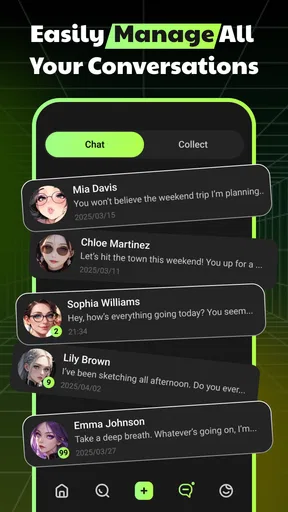
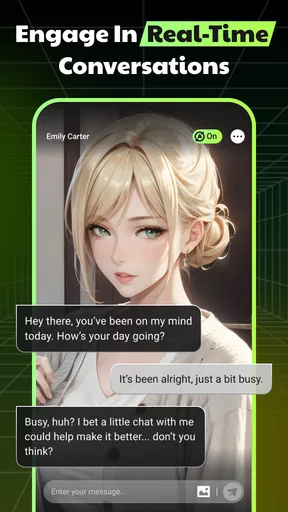
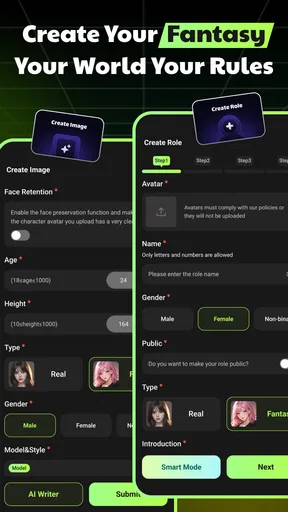
Our Review of SayHi : Chat Now
 Analysis by Appyee
SayHi: Chat Now caught my attention because it turns AI conversation into something more structured than opening a blank chatbot and wondering what to ask. It is an entertainment app built around role-play chats and collectible character cards, so the appeal is immediate: choose a personality, start a conversation, and see where the exchange goes. I found it easy to understand in the first session, but the more important question is whether that initial curiosity becomes a habit.
My short answer is that it can, especially if you enjoy improvising conversations, experimenting with fictional personalities, or using a chat app as a small escape during quiet moments. It is less convincing for anyone looking for a practical assistant, a serious social network, or a replacement for real human conversation. The experience depends heavily on how much effort you are willing to put into starting and steering each interaction.
Developed by Maju bersama, the app is free to install and aimed at mature users aged 17 and above. It has reached over one hundred thousand installs and holds a 4.8 average from around nineteen thousand ratings, which suggests that the basic idea connects with a sizable audience. I tested it with one question in mind: after the novelty of talking to virtual characters fades, does collecting and returning to those characters still feel worthwhile?
What the first week feels like
I found the first week most revealing when I stopped treating every character as a fresh novelty and started noticing how the app fits into different moods and routines. In this section, I look at the practical feel of returning to SayHi: what makes a quick session easy to begin, and what can make it feel effortful. That distinction helps show whether its card-led format suits your everyday habits.
Fast entry, clear entertainment value
The strongest part of the first week is the low barrier to entry. SayHi does not ask me to learn a complicated system before I can enjoy it. The character-card approach gives the experience a visible starting point: instead of facing an empty text field, I can browse toward a particular kind of interaction and begin with a role already suggested by the character.
That matters more than it may sound. A general AI chatbot can be flexible, but that flexibility often creates work for the user. I have to invent a scenario, define the tone, and explain what I want. Here, the collectible-card framing supplies enough direction to make the first conversation feel like entertainment rather than a task. The result is particularly comfortable for short sessions when I want something to do without committing to a game or a long video.
The role-play format also gives ordinary questions a little more energy. Asking for advice, setting up an imaginary situation, or simply testing how a character responds feels different from asking the same thing in a neutral assistant window. I enjoyed trying deliberately unexpected prompts because the fun came from seeing whether the character could maintain its identity instead of merely producing a useful answer.
Why the card collection changes the experience
The cards are not just decoration in my view. They create a browsing habit. I found myself thinking less about “using an AI” and more about choosing the right conversational mood. That distinction helps SayHi compete with passive entertainment: when I have a few spare minutes, selecting a character can be more engaging than scrolling through an endless feed.
There is also a useful psychological effect in having several possible conversation partners. A single chatbot can begin to feel repetitive because every session starts from the same place. Character cards provide a reason to vary the interaction, even when the underlying activity remains typing and reading. For someone who enjoys fictional personalities, this is the feature most likely to keep the first week interesting.
My practical tip is to give each new character a clear opening situation rather than sending a vague greeting. A small premise—such as asking for help with a fictional problem or beginning in the middle of an imagined scene—usually produces a more satisfying role-play than expecting the app to create all the momentum by itself. This is one of the first trade-offs: SayHi makes starting easier, but the quality of the session still improves when I contribute some creativity.
A realistic everyday session
Imagine finishing work or classes and having ten minutes before dinner. You do not want to start a full game, and you are not in the mood for another social feed. In that situation, I can see SayHi working well. I might open a character, continue a light role-play conversation, and stop when the exchange loses momentum. The session has a beginning and an end without demanding a large time commitment.
That same scenario also exposes the app’s limit. If I am tired and do not want to write anything imaginative, the experience can become passive and thin. The application responds to the quality of the prompt and the direction I provide, so it is not a completely effortless form of entertainment. It is closer to interactive improvisation than to watching a finished show.
Who should be careful before installing
The mature rating deserves attention. I would not treat SayHi as a general family app, and I would not hand it to a younger user simply because the interface looks approachable. Adults who are comfortable with fictional role-play are the natural audience. People who prefer strictly family-friendly entertainment, predictable educational content, or clearly bounded conversations should choose something else.
I would also avoid presenting it as emotional support. A character can be pleasant to talk to, but that does not make the interaction a substitute for a trusted friend, counselor, or professional service. The entertainment framing is healthiest when I keep the relationship with the app in perspective: it is a responsive fictional experience, not a person with responsibility for my wellbeing.
Whether it earns a place after the novelty
After the initial curiosity, I judge the app less by how many characters I can browse and more by whether a conversation still feels worth opening on an ordinary day. This section considers what keeps the experience engaging, where repetition sets in, and how I would decide whether it deserves regular space on my device.
Month-to-month value comes from variety
Longer-term value depends on whether the character collection continues to give me different reasons to return. The app is not automatically durable just because it uses collectible cards. Collection can create a short burst of motivation, but once I have seen the available styles that interest me, the conversations themselves must carry the experience.
In my view, SayHi has the best chance of becoming a recurring entertainment app for users who enjoy making their own scenarios. I can return with a new premise, change the tone of a conversation, or use the same character in a different fictional setting. That makes the app more replayable than a linear story, because I am not simply consuming the same sequence every time.
The trade-off is that this replayability is user-powered. If I want a tightly written narrative with carefully controlled character development, a story game or interactive fiction app will probably offer a stronger long-term arc. SayHi is more open-ended, but open-ended systems can feel less rewarding when I am looking for progression that the app itself clearly manages.
How it compares with ordinary alternatives
Compared with a standard AI assistant, SayHi is more focused on personality and entertainment. A conventional assistant is usually the better choice for planning, factual tasks, drafting practical messages, or organizing information. I would not open SayHi first to manage a schedule or solve a work problem; its appeal is the atmosphere of the exchange, not productivity.
Compared with social media, the experience is quieter and more controlled. I am not waiting for replies from strangers or moving through a constantly changing public feed. That can make it a better fit when I want interaction without social pressure. On the other hand, it does not provide the unpredictability, genuine connection, or shared memories that come from talking with real people.
Compared with a traditional game, SayHi asks less of me in terms of rules and skill. There is no need to master controls or understand a large world before beginning a conversation. But that simplicity also means it may not satisfy users who need challenge, goals, exploration, or a strong sense of achievement. The collectible element adds direction, yet it does not turn the app into a conventional game.
The cost question changes over time
Although the app is free, in-app purchases range from $3.49 to $109.99 per item. That makes it important to decide early whether the free experience already gives me enough enjoyment. I would not spend simply because a card looks interesting or because I feel pushed to complete a collection. The sensible approach is to use the free access as a test of the conversations themselves before considering any optional purchase.
This is also where the collection design can create friction. Collectible systems naturally encourage comparison between what I have and what I could obtain next. For some users, that adds harmless motivation. For others, it can turn a relaxed chat app into a spending temptation. I recommend setting a personal limit before browsing paid items, particularly because entertainment value can feel more urgent in the moment than it does a day later.
A useful long-term test is simple: remove the collecting impulse from the decision and ask whether I would still open the app to talk with the characters I already have. If the answer is yes, SayHi has genuine recurring value for me. If the answer is no, additional cards are unlikely to solve the underlying problem; they may only restart the novelty cycle temporarily.
The maintenance burden is mostly mental
SayHi does not feel demanding because of complicated controls. The maintenance burden comes from keeping conversations fresh. I need to remember which characters I enjoyed, avoid repeating the same opening, and bring enough imagination to give each session a direction. That is not difficult, but it is a real cost, especially when I use the app frequently.
I found a lightweight routine helpful: keep one character for casual conversation, another for more deliberate role-play, and stop a session when the exchange begins circling the same idea. This prevents me from forcing a conversation past its natural endpoint. It also makes returning later feel more intentional instead of opening the app automatically and hoping it will entertain me.
Another practical insight is to treat the cards as prompts rather than commitments. I do not need to pursue every character or maintain a relationship with each one. Choosing only the personalities that produce distinct conversations reduces clutter and makes the collection feel more personal. The app becomes easier to revisit when I am not trying to extract value from every available option.
Where fatigue starts to appear
The first source of fatigue is repetition. Even when characters have different identities, the basic rhythm remains familiar: I write, the character responds, and I decide how to continue. If I use the app for long stretches or return several times a day, that pattern can become noticeable. The collectible presentation delays this feeling, but it cannot remove it entirely.
The second source is uneven conversational momentum. Some sessions begin with a strong premise and naturally develop; others require too much prompting from me. When I have to repeatedly rescue a flat exchange, the entertainment value drops quickly. This is why I see SayHi as better for short, self-directed visits than for marathon use.
The third is the gap between imagined personality and actual consistency. Role-play is most enjoyable when a character feels stable enough to recognize, but not so rigid that every answer sounds identical. If the responses drift away from the character I selected, the card loses some of its purpose. I would rather have a smaller set of memorable personalities than a large collection that feels interchangeable.
There is also a privacy-minded habit I would recommend with any conversational AI entertainment app: avoid sharing sensitive personal details simply because the exchange feels private or friendly. I keep my prompts fictional or general unless there is a clear reason to do otherwise. That does not reduce the fun; it gives the role-play a safer boundary and keeps the app in its proper category.
Technical fit and version context
SayHi currently appears as version 2.7.6 and supports devices running Android 7.0 or newer. That broad compatibility makes it accessible to people who are not using the newest phone, although the experience will still depend on the device and connection in everyday use. I would check the operating-system requirement before planning around an older handset.
The app’s release date was April 23, 2025, so I see it as a relatively recent entertainment option rather than a long-established platform with years of personal history behind it. That is not automatically a weakness, but it affects how I judge durability. A new app can feel exciting because the format is unfamiliar; lasting value has to be demonstrated by the quality of repeated sessions, not by the first impression alone.
Who gets the most from it
I would recommend SayHi to adults who enjoy character-driven improvisation, like trying different conversational moods, and want a lightweight activity for short breaks. It is especially suitable for someone who finds a blank chatbot too directionless but does not want the rules and commitment of a full game. The cards provide enough structure to begin, while the open conversation leaves room for personal creativity.
I would be more cautious recommending it to people who want dependable factual answers, a serious productivity tool, or a deep story with guaranteed progression. Those users are likely to be happier with a conventional assistant, interactive fiction, or a narrative game. I would also skip it if collectible purchases tend to make entertainment feel stressful rather than playful.
My long-term verdict
After the first-week excitement fades, SayHi: Chat Now earns a place on my device only if I approach it as a small role-play playground, not as an endlessly expanding social world. The character-card format is a smart way to make AI conversation feel more inviting, and the free entry point makes it easy to discover whether that style suits me. Its strongest sessions are personal, imaginative, and brief.
The lasting value is in the conversations I create, not in collecting for its own sake. That is both the app’s main strength and its clearest limitation. Users who bring fresh scenarios and keep sensible boundaries can return regularly without needing a large time investment. Users who expect the app to supply constant novelty, deep emotional connection, or game-like progression may feel the repetition sooner.
My final recommendation is therefore selective but positive. Try it if you want mature, character-based AI entertainment and are comfortable treating virtual personalities as a creative pastime. Spend cautiously, keep personal information out of fictional chats, and judge the app after several ordinary sessions rather than one exciting first encounter. For me, that is enough to make it worth keeping as an occasional companion for imaginative breaks, but not enough to replace the practical tools, real relationships, and richer games I use for other purposes.
Verdict
Strengths of SayHi : Chat Now
- Supports voice messages for more natural conversations.
- Simple interface makes starting a chat quick and easy.
- Useful for meeting people beyond your local social circle.
- Chat history helps you continue conversations later.
- Available on both Android and iOS devices.
Limitations of SayHi : Chat Now
- Some features may require in-app purchases or premium access.
- Public conversations can include spam or unwanted messages.
- Privacy settings may need adjustment before using the app.
- Matching results may vary depending on your location.
- Requires an internet connection for messaging and discovery.
Similar Picks in This Category
View All
Google Play Games
Google LLC3.9

Netflix
Netflix, Inc.4.8

YouTube Kids
Google LLC4.2

Disney+
Disney4.4

Prime Video
Amazon Mobile LLC4.7

Steam
Valve Corporation3.2
Frequently Asked Questions
What is SayHi: Chat Now, and what can I use it for?
SayHi: Chat Now is a language translation app designed to help people communicate when they speak different languages. You can enter or speak a phrase, choose the source and target languages, and receive a translated result. It can be useful while traveling, chatting with international friends, ordering food, asking for directions, or handling simple everyday conversations without relying on a dictionary.
Which languages does SayHi: Chat Now support?
The app supports a broad selection of languages and dialects, although the exact list may vary depending on the device, operating system, and current app version. Some languages may offer both text and voice translation, while others may have more limited features. Before downloading, check the latest store description to confirm that your preferred languages and translation modes are available.
Does SayHi: Chat Now work with voice input and spoken translations?
Yes, one of the app’s main advantages is its voice-based conversation experience. You can generally speak into the microphone, view the translated text, and listen to the result using text-to-speech. This makes short conversations more natural than typing everything manually. However, pronunciation, background noise, accents, and unclear speech can affect recognition accuracy, so reviewing the translated text is recommended.
Do I need an internet connection to use SayHi: Chat Now?
SayHi: Chat Now is primarily intended to work with an internet connection because translation and speech-processing features may depend on online services. Availability without a connection can be limited, and offline functionality should not be assumed for every language or feature. If you plan to use it abroad, test the app beforehand and consider arranging mobile data or reliable Wi-Fi.
Is SayHi: Chat Now accurate, private, and free to use?
The app is convenient for everyday phrases and basic conversations, but it should not replace a professional interpreter for legal, medical, financial, or highly sensitive communication. Translation quality depends on language pair, context, and speech clarity. Review the current privacy policy and store listing before using it, since voice and text may be processed to provide translations and pricing or usage terms can change.
